One Flight, One Surgery: What a Tokyo Implant Visit Can Realistically Finish Before You Board
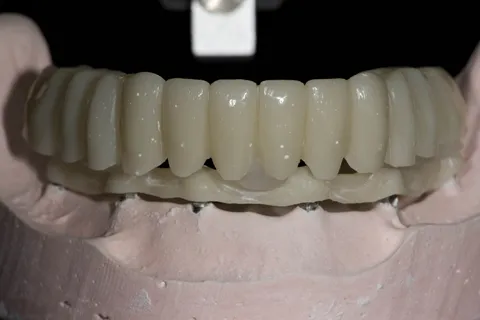
Photo: FixtTeeth, CC BY-SA 4.0, via Wikimedia Commons
Every few weeks a reader writes to ask whether an entire implant can be finished in one trip to Tokyo. The candid answer is that roughly half of it can be completed — and the half that cannot is the half that determines whether the treatment is still functioning a decade from now.
What follows is a practical map of the timeline, written for patients flying from the United States with a limited window abroad.
The Biology Sets the Schedule, Not the Airline
After an implant is placed, the surrounding bone must grow into direct contact with the titanium surface, a process called osseointegration. In the lower jaw this typically takes three to four months; in the upper jaw, where bone is softer, four to six. Sites that required grafting, or that sit near the maxillary sinus, take longer still.
No clinic in Tokyo, Tucson, or anywhere else can meaningfully shorten that interval without trading away predictability. Japanese treatment plans tend to treat the waiting period as a formal stage with its own review appointment rather than dead time between procedures, which is useful for a traveler: it makes the timeline explicit, in writing, before surgery is scheduled.
What Fits Comfortably Inside Seven to Ten Days
A well-organized Tokyo practice can accomplish the following in a single visit of about a week to ten days:
- Consultation and imaging. Cone-beam CT is standard in Japanese implant planning; many clinicians will not proceed without it, and it is usually performed on the same day as the first examination.
- Medical review. Medication list, allergy history, blood pressure, and where indicated, HbA1c and other laboratory work.
- Extraction with bone grafting, if required. This is the single most common reason a one-trip plan collapses: grafting typically adds four to six months before an implant can be placed.
- Implant surgery itself. A single site usually takes 45 to 90 minutes under local anesthesia.
- Post-operative reviews. Most clinics schedule a check at three to seven days, with suture removal at seven to ten.
- A provisional restoration, in carefully selected cases only.
What Should Not Be Rushed
The final impression, custom abutment, and definitive crown all depend on completed healing. So does second-stage surgery for implants placed beneath the gum line. Soft-tissue shaping is another stage that Japanese clinicians often stretch across several weeks of provisional wear, because the emergence profile — the way the gum meets the crown — is difficult to correct later.
A clinic that offers to skip these steps is not offering efficiency. It is offering a shorter warranty period in disguise.
Immediate Loading: Legitimate in Narrow Cases
Placing a crown on the day of surgery is defensible for a single tooth when primary stability is high (insertion torque of roughly 35 Ncm or more), no grafting was needed, the opposing bite is stable, and the patient does not clench or grind. It is a poor fit for a traveler when it is applied to full-arch reconstruction, which requires frequent follow-up during the first months of healing — follow-up that will be happening five thousand miles away.
The Paperwork That Determines Your Aftercare at Home
This is where single-trip patients most often run into trouble, and it has nothing to do with surgery.
Ask for the implant's brand, model, and lot number. Confirm which distributor supplies that system in the United States; several implant lines popular in Japan have thin American distribution, and a US dentist cannot order a prosthetic component that is not sold in the country. Ask for the insertion torque value, the graft material used, the surgical note in English, the CBCT files in DICOM format, and any intraoral scans in STL. Request the whole package as a single digital folder before you leave Japan, while the records are still easy to assemble.
Ten Questions Worth Settling Before You Book
- What is the minimum number of in-person visits this plan requires, and can they be scheduled within my dates?
- Which stages must take place in Tokyo, and which can be completed by my dentist at home?
- If grafting turns out to be necessary, how does the schedule change?
- Which implant system will be used, and who distributes it in the US?
- What records will I receive, and in what formats?
- Who answers a complication during my first week back in the States, and in which time zone?
- Will the clinic speak directly with my US dentist?
- What is the total cost in yen, what does it exclude, and how is consumption tax handled?
- What are the warranty terms, and do they survive my departure from Japan?
- If the implant fails after I leave, what is the replacement or refund policy?
Flying Home After Surgery
Most surgeons prefer patients to remain in the country for seven to ten days. Swelling peaks at 48 to 72 hours, and a long-haul flight in the cabin's dry air is more comfortable once the acute phase has passed. Carry the surgical summary in English, keep the clinic's contact details on your phone, and mention the implant if you are questioned about medications at security.
A Two-Trip Model That Works
The arrangement that fits most US patients is straightforward. Trip one covers eight to ten days: consultation, imaging, surgery, and the early post-operative checks. Trip two, four to six months later, covers six to eight days: final impression and delivery of the crown — or, if preferred, a clean handoff of records to a dentist near home.
One flight can buy you the surgery. It cannot buy you the healing, and it is the healing that you are actually paying for.